
Canada Spousal Sponsorship: Key Questions
- June 11, 2026
- Kunpeng Global
- 8:55 pm
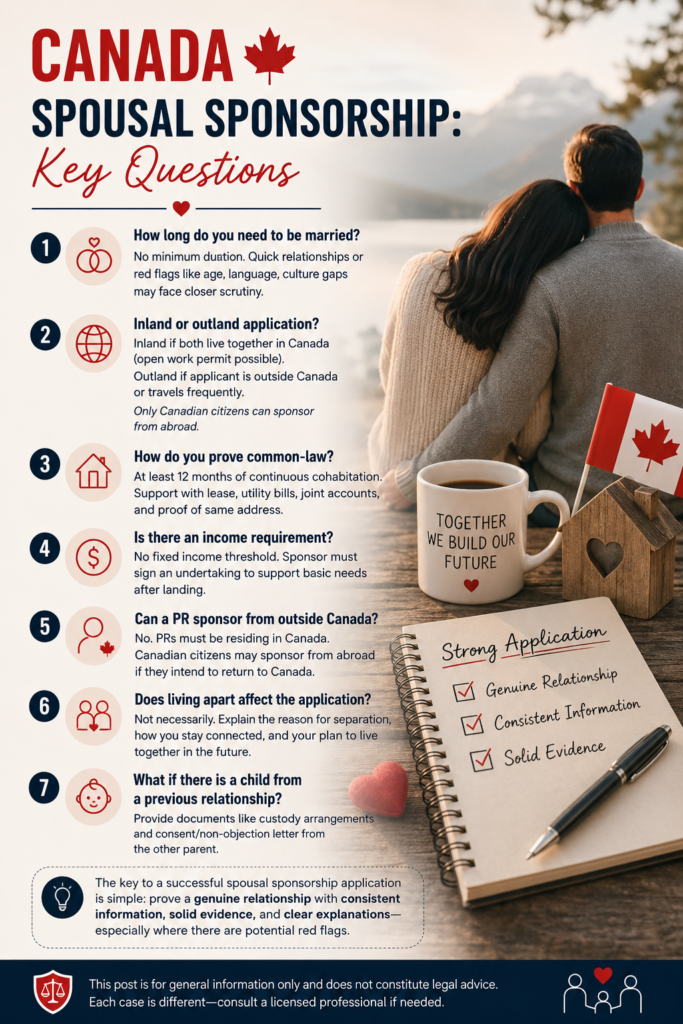
Over the years, I have handled many spousal sponsorship cases, including my own.
It remains one of the most common immigration pathways in Canada, and also one of the most misunderstood.
Here are some key questions often asked:
1. How long do you need to be married before applying?
There is no minimum marriage duration.
However, applications may face closer scrutiny where the relationship developed quickly or where there are notable differences in age, language, culture, or prior immigration history.
2. Inland or outland application?
If both spouses are living together in Canada, inland may be appropriate and can include eligibility for an open work permit.
If the applicant is outside Canada or travels frequently, outland (family class) is often more practical.
Only Canadian citizens may sponsor while residing outside Canada.
3. How do you prove common-law relationship?
Generally, continuous cohabitation for at least 12 months is required.
Evidence may include joint lease or ownership documents, shared financial records, and proof of the same residential address.
4. Is there a minimum income requirement?
There is no fixed income threshold.
However, the sponsor must sign an undertaking to financially support the spouse’s basic needs after landing.
5. Can a permanent resident sponsor from outside Canada?
No. Permanent residents must be residing in Canada to sponsor.
Canadian citizens may sponsor from abroad if they can show intent to return once the application is approved.
6. Does living apart affect the application?
Not necessarily. Many couples live apart due to work, studies, or family obligations.
What matters is explaining the reason clearly and showing how the relationship is maintained and the plan to reunite.
7. What if there is a child from a previous relationship?
This is common and requires supporting documents such as custody arrangements and consent or non-objection letters from the other parent where applicable.
A genuine relationship supported by coherent information, credible evidence, and clear explanations where needed.
📌 This post is for general information only and does not constitute legal advice. Each case should be assessed individually.