
PGWP: Where Policy Meets Discretion
- July 7, 2026
- Kunpeng Global
- 4:36 pm
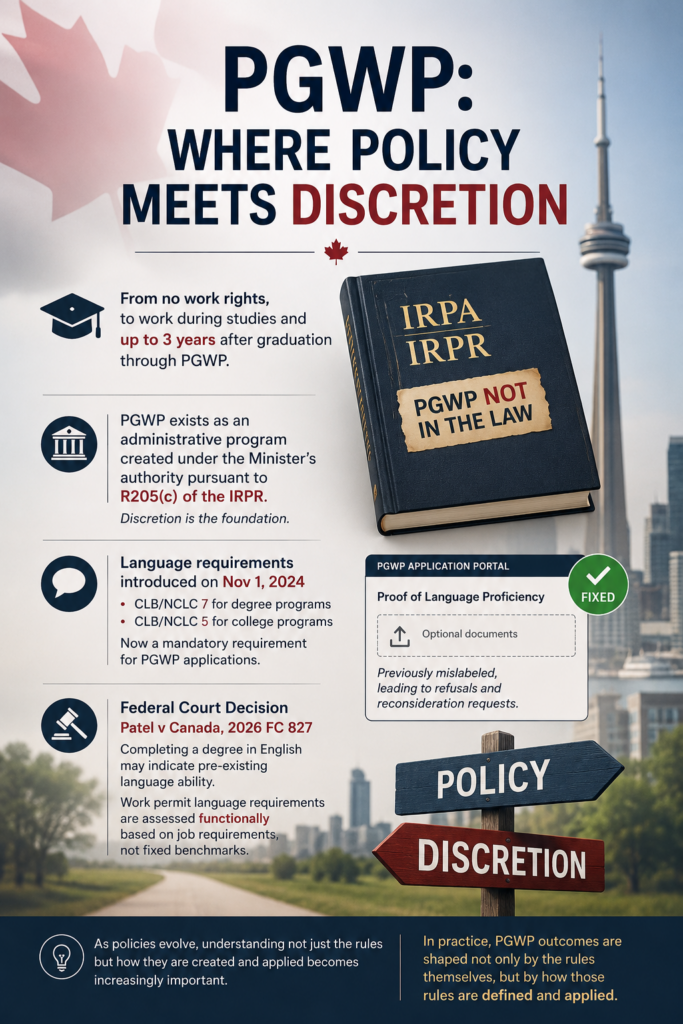
I come from a time when international students in Canada were not allowed to work. Today, not only can they work during their studies, but they may also stay and work for up to three years after graduation through the Post-Graduation Work Permit (PGWP).
It is easy to view Canada as generous in its immigration approach compared to many other countries. However, this generosity also brings complexity and, at times, controversy.
One interesting aspect is that, unlike study permits or LMIA-based work permits, the PGWP is not explicitly set out in the IRPA or Regulations. Instead, it exists as an administrative program, created under the Minister’s authority pursuant to R205(c) of the IRPR. This discretionary power forms the entire legal foundation of the program.
Because of this, the Minister can redefine eligibility criteria without formally amending the Regulations. For example, on November 1, 2024, language requirements were introduced through updates to program delivery instructions (CLB/NCLC 7 for degree programs and 5 for non-degree college programs). Since then, language proficiency has become a mandatory requirement for PGWP applications.
However, lately, despite being mandatory, the portal’s “Proof of Language Proficiency” upload field was misleadingly labeled as “Optional documents.” This inconsistency has led to refusals and subsequent reconsideration requests. Luckily, it has been fixed by IRCC.
A recent Federal Court decision (Patel v Canada, 2026 FC 827) adds another layer to the discussion. In the context of employer-specific work permits, the Court recognized that completing a degree in English indicates pre-existing language ability. This highlights an important distinction: language ability for such work permits are often assessed functionally based on job requirements, rather than through fixed benchmarks as seen in the PGWP program.
As policies evolve, understanding not just the rules but how they are created and applied becomes increasingly important.
In practice, PGWP outcomes are shaped not only by the rules themselves, but by how those rules are defined and applied.