
Employment Letter can do wrong to your application
- July 8, 2026
- Kunpeng Global
- 4:54 pm
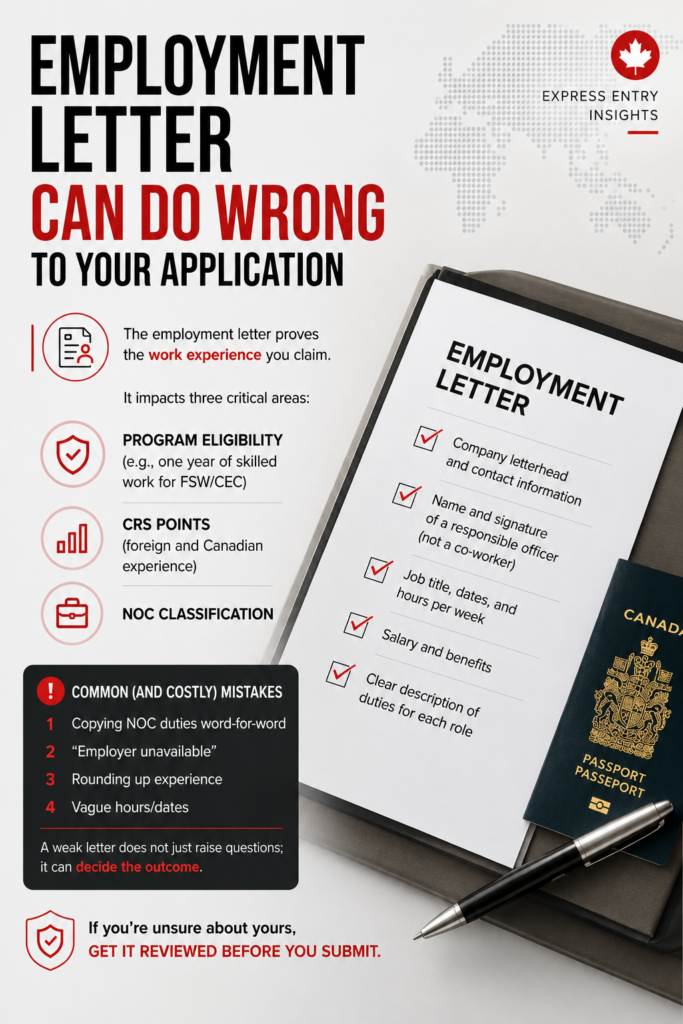
If you ask me which document gets questioned the most in an Express Entry application, I will say the employment letter.
It is arguably the most consequential document after the language test, and the one most commonly troubled with.
Its core function is simple: to prove the work experience claimed. Such claim drives three critical determinations:
• Program eligibility (e.g., one year of skilled work for FSW/CEC)
• CRS points (foreign and Canadian experience)
• NOC classification
Keep this in mind: an officer’s job is to verify that your actual duties substantially match the lead statement and main duties of the claimed NOC (TEER 0–3).
That’s why IRCC expects the letter to include:
• Company letterhead and contact information
• Name and signature of a responsible officer (not a co-worker)
• Job title, dates, and hours per week
• Salary and benefits
• Clear description of duties for each role
Common (and costly) mistakes:
1. Copying NOC duties word-for-word → Duties must be genuine and written in the employer’s own language
2. “Employer unavailable” → Use alternatives: former supervisor letters, contracts, T4s/pay records + explanation
3. Rounding up experience → If the letter can’t support it, it hurts the application
4. Vague hours/dates → Full-time or properly documented part-time equivalency.
A weak letter does not just raise questions; it can decide the outcome.
If you’re unsure about yours, get it reviewed before you submit.