
Understand the process, and preparation follows
- July 14, 2026
- Kunpeng Global
- 5:21 pm
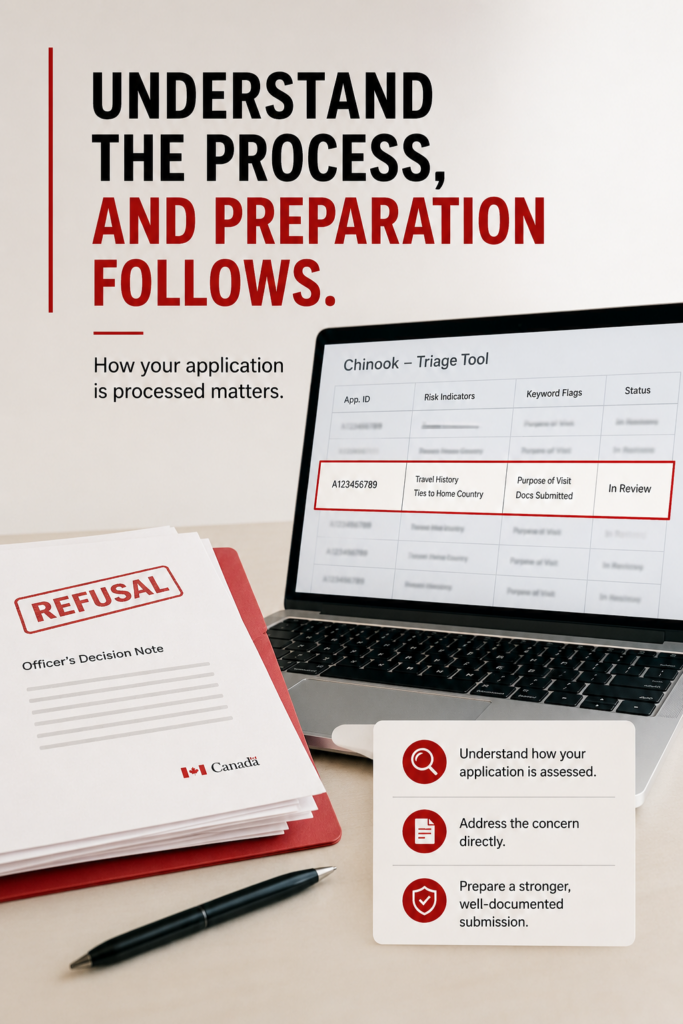
Years ago, a visitor visa (or any temporary resident application) refusal told you almost nothing. The letter was vague and template. Applicants tried repeatedly without knowing why they failed. The only way to learn the real reason was to request the officer’s notes from IRCC. These are commonly called GCMS notes, Global Case Management System, the internal database where IRCC keeps every application, every document, and every note an officer writes about your file.
Things have improved. Today an Officer’s Decision Note (ODN) usually comes with the refusal letter, and it generally matches what is in the GCMS notes. If you want to resubmit, you finally know what the officer actually weighed, and you can meet that concern head-on instead of guessing.
Even so, many applicants read the ODN and are still confused. They think they provided documents that prove exactly this. Why was it not enough?
This is when you need to understand how such application is processed.
IRCC uses a triage tool called Chinook. It is Excel-based, piloted in 2018 and launched in 2019. It does not make decisions. What it does is pull your information out of that same GCMS database and display it to officers in spreadsheet form. Your whole application becomes one row among many, with risk indicators and keyword flags attached.
This affects your application in three ways:
1. The officer may be reviewing the spreadsheet extraction, not the entire file. A fact that is not extracted risks never being weighed.
2. Boilerplate refusals still happen, and there are legitimate concerns about how applicant data is analyzed behind the scenes.
3. Risk indicators and keyword flags could introduce systemic bias into officer discretion.
The good news is that an application which visibly grapples with the prior refusal reasons is much harder to refuse on the same template ground.
However, what you said in the old file travels with you. GCMS carries every version forward, and an inconsistency in a new application creates a misrepresentation exposure far worse than the original refusal.
If you have been refused and are deciding between reconsideration, reapplying, or judicial review, the notes are where the analysis starts.