
When Immigration Applications Go Beyond Processing Time
- July 15, 2026
- Kunpeng Global
- 5:25 pm
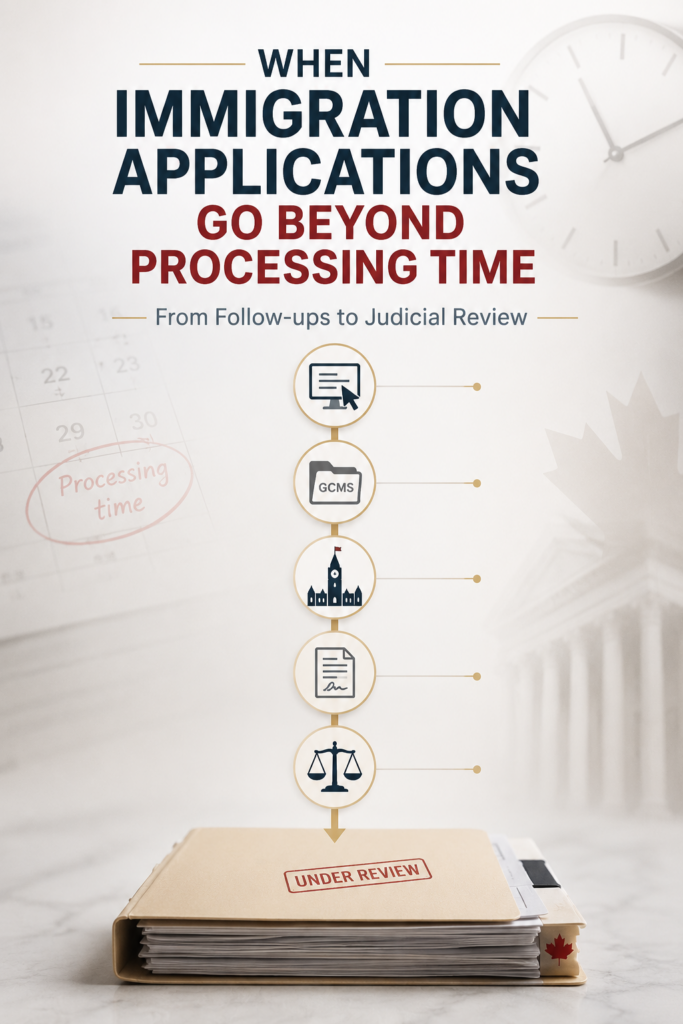
We have seen many immigration applications go well past the posted processing time.
There are several steps an applicant can pursue:
1. IRCC webform / status check
This rarely produces immediate movement, but it creates a paper trail showing that the applicant has been actively and diligently following up on the delay.
2. Request GCMS / ATIP notes
GCMS notes may provide insight into whether there is an explanation behind the delay, whether the file is waiting on a specific step, or whether there is simply no visible progress.
3. MP (Member of Parliament) inquiry
In many cases, IRCC responds to MP offices faster than to regular webforms. While an MP inquiry does not guarantee approval or a decision, it sometimes helps move a dormant file forward.
4. Demand letter to IRCC
A formal demand letter can be sent requesting that IRCC make a decision within a stated period, normally 30 to 60 days, while advising that the applicant may seek mandamus if no decision is made.
5. Seeking mandamus through judicial review (JR)
Mandamus is a Federal Court process asking the Court to order IRCC to make a decision. This process must be represented by a lawyer, and the Court does not order IRCC to approve an application. It orders IRCC to make a decision.
You may have already submitted multiple webforms, and sometimes GCMS notes come back with very limited information or even appear blank. However, these records are still important.
They demonstrate that the applicant has made consistent efforts to follow up, and they can become evidence showing that the delay is not merely lengthy, but potentially unreasonable.
Therefore, many steps taken before judicial review may not directly move the file, but they become part of the evidentiary record.
Another issue we frequently see is IRCC relying on security screening as the reason for delay.
Federal Court decisions have repeatedly emphasized that a general statement referring to security concerns is not sufficient. The Minister must provide evidence supporting the reasonableness of the delay.
Clients often raise a concern that judicial review could be a double-edged sword because a decision made under court pressure may result in a rush refusal.
This is understandable; but keep this in mind, a decision made under a court deadline still must meet the requirements of reasonableness and procedural fairness.
A delay is frustrating, but a well-documented process is what protects an applicant’s position when waiting becomes unreasonable.