
Fewer Newcomers, Bigger Labour Gaps
- April 23, 2026
- Kunpeng Global
- 8:29 pm
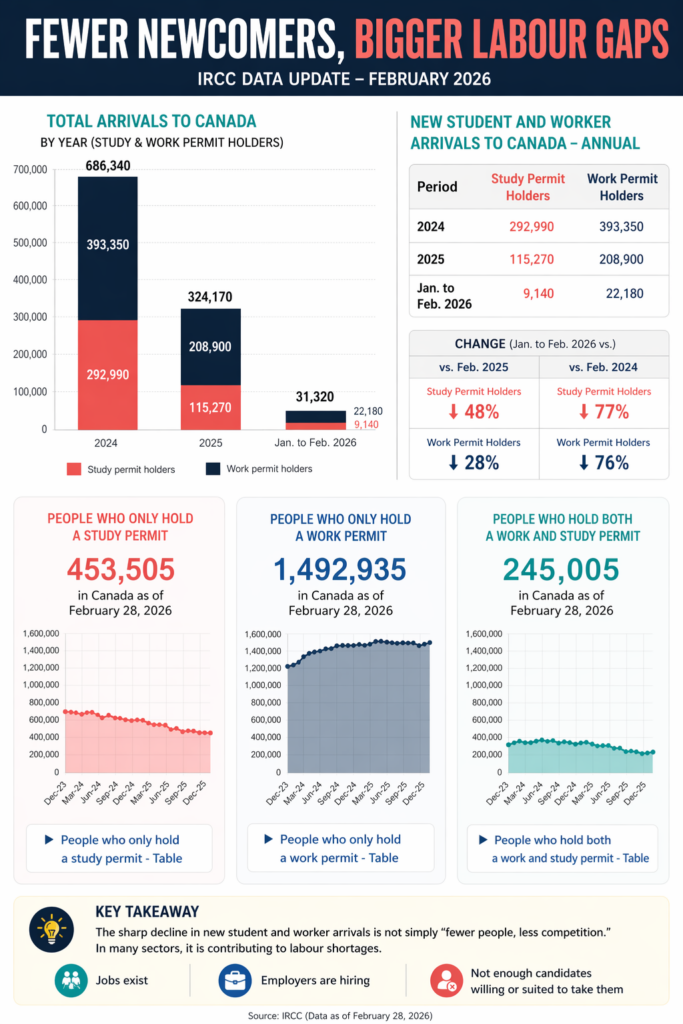
IRCC released a data update showing that the number of new international students and foreign workers arriving in Canada declined again in February.
At first glance, this may appear to be a positive correction. Given the current public discourse on housing pressure, job competition, and strain on services, it is easy to assume that fewer newcomers will ease these challenges.
But this interpretation misses a critical point.
Let’s first look at the actual figures:
• International students:
2,135 arrivals in February 2026
48% decrease compared to February 2025
77% decrease compared to February 2024
• Foreign workers:
10,375 arrivals in February 2026
28% decrease compared to February 2025
76% decrease compared to February 2024
At the same time, we are seeing real changes on the ground:
• Institutions closing campuses, cutting programs, and reducing staff
• Employers adjusting hiring expectations downward
• Candidates being asked to consider lower-level roles
Some positions, especially lower-level or entry roles, remain difficult to fill.
I recently came across a situation where an applicant for a supervisory role was asked whether they would accept a lower-level position instead. Interestingly, despite this adjustment, the role still appeared difficult to fill.
This leads to an important clarification.
The current social and economic pressures are not caused by newcomers.
In certain sectors, the reduction in newcomers is actually contributing to labour shortages.
International students and foreign workers have long played a role in filling jobs that are:
• Lower-wage
• Shift-based
• Less attractive to the domestic workforce
With significantly fewer individuals entering Canada under these streams, the labour supply in these segments is shrinking.
The result is not a simple “fewer people, less competition” outcome.
Instead, we are seeing:
• Businesses struggling to fill essential roles
• Operational gaps in service-based industries
• A growing mismatch between available jobs and available workers
There are jobs, but not enough candidates who are willing or suited to take them.
Blaming newcomers for systemic issues may be politically convenient, but it does not align with what the data and on-the-ground reality are showing.
I am not here to offer solutions, but to point out what the facts are already telling us.