
Understanding Immigration Law in Practice
- July 3, 2026
- Kunpeng Global
- 4:24 pm
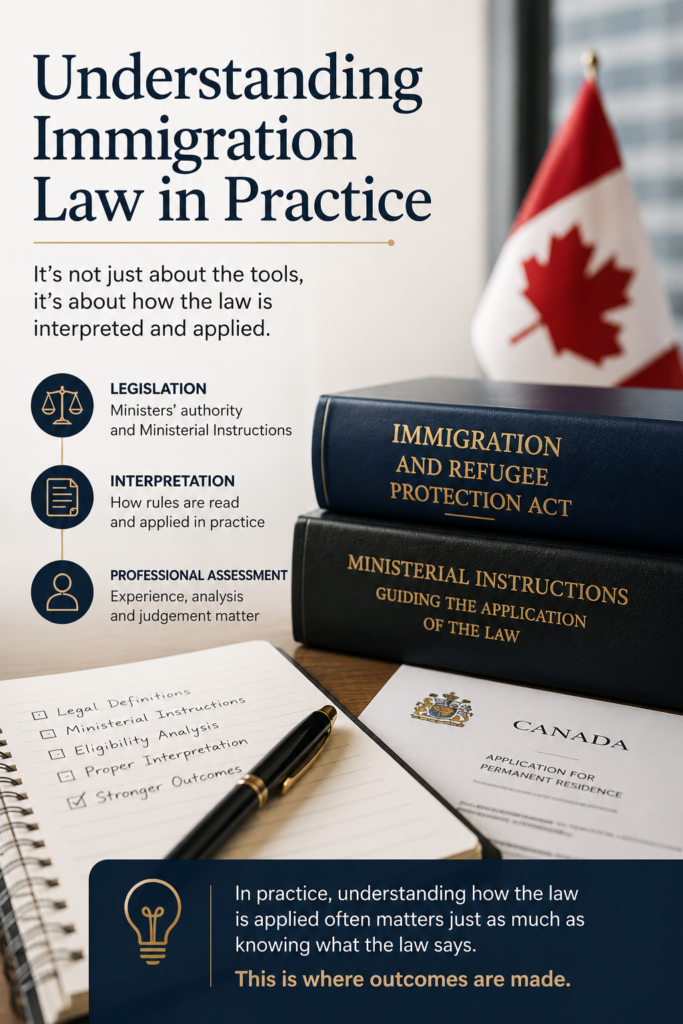
During my limited time studying at Queen’s Law, I found Canada’s legislative system particularly interesting. The law-making process, the debates, and the Royal Assent all reflect a structured and thoughtful framework.
What stood out even more is that Ministers have the authority to issue what can be considered “quasi-laws” to respond efficiently to economic or public policy changes without formally amending legislation.
For example, the Minister of Immigration, Refugees and Citizenship Canada issues Ministerial Instructions (MIs). These instructions guide how the legislation is applied in practice.
I bring this up because when submitting an application in Canada, compliance with the law is essential. However, in many cases, applicants are not fully aware of how these rules operate beyond the surface level.
A question I often receive is whether I rely on the official Express Entry CRS tool when assessing a candidate’s score.
The answer is yes, but only as an initial reference.
The tool provides a useful projection, but it does not account for how legal definitions are interpreted in immigration law, which can differ significantly from common understanding. When I assess a candidate’s score, I always refer back to the Ministerial Instructions respecting the Express Entry system to determine how the rules are actually applied.
This also connects to another common question. If the CRS score can be calculated online, what is the difference in professional assessment?
The difference lies in understanding how the rules are read and applied.
Even the Ministerial Instructions themselves can require interpretation.
For instance, paragraph 15(7)(a) states that if a foreign national is engaged in full-time study, the employment during that period cannot be counted as work experience.
At the same time, as discussed in a previous post, if the study is conducted online and from a foreign institution, that work experience may still be eligible.
This leads to a more nuanced situation. If that same study results in a higher education credential, can this credential be counted or create a conflict with the rule?
The answer is it is not considered ‘study’ for the purposes of paragraph 15(7)(a), therefore, such credential stays.
This is a level of detail that the online CRS tool does not capture.
In practice, understanding how the law is applied often matters just as much as knowing what the law says.